Fix Runtime
Apply self-healing fixes at runtime.
Held for the beta — off by default, and no fix reaches it
The Fix Runtime is built, and it is held for the beta. It is off by default since Python 0.4.0 and JavaScript 0.7.0: init() starts it only with fix_runtime=True (or RISICARE_FIX_RUNTIME=true). The route that it reads, GET /v1/fixes/active on the API host, is not reachable with an API key during the beta, so a runtime that you start logs a warning and loads no fix. Diagnosis is held, so no new fix is generated, and fix deployment is gated off, so no fix can be put into a live status. Keep the Fix Runtime off. This page describes the runtime as built.
The Fix Runtime enables dynamic application of fixes without redeployment.
Overview
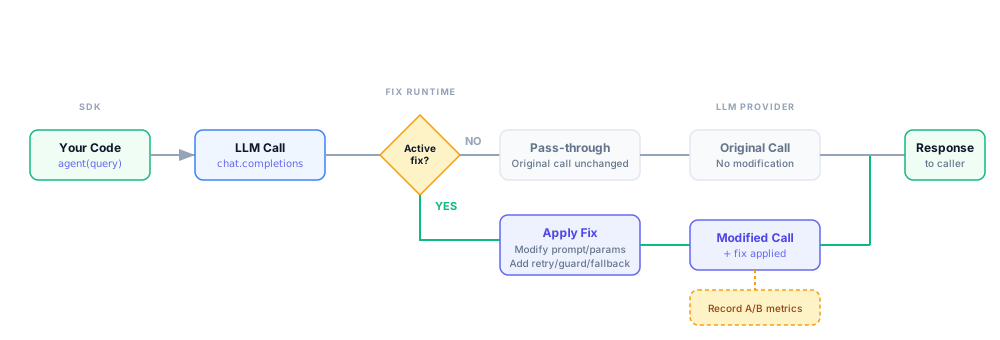
When Risicare detects an error pattern and generates a fix, the Fix Runtime can apply it immediately:
from risicare.runtime import FixRuntime, FixRuntimeConfig

runtime = FixRuntime(
    config=FixRuntimeConfig(
        api_endpoint="https://api.risicare.ai",
        api_key="rsk-...",
        enabled=True,
    )
)

runtime.start()
Getting Started
A complete setup that initializes the fix runtime alongside the SDK:
import risicare
from risicare import init_runtime, get_runtime, shutdown_runtime
from risicare.runtime import FixRuntimeConfig

# 1. Initialize SDK (tracing + auto-instrumentation).
#    fix_runtime stays False, so init() starts no runtime.
risicare.init(api_key="rsk-...", environment="production")

# 2. Configure fix runtime
config = FixRuntimeConfig(
    api_endpoint="https://api.risicare.ai",
    api_key="rsk-...",
    cache_ttl_seconds=300,        # Cache fixes locally for 5 minutes
    refresh_interval_seconds=60,  # Poll API for new fixes every minute
    dry_run=False,                # Set True to log fixes without applying
    ab_testing_enabled=True,      # Enable A/B traffic splitting
)

# 3. Initialize and auto-start (fetches active fixes from API)
runtime = init_runtime(config=config, auto_start=True)

# 4. Use anywhere in your application
runtime = get_runtime()
fix = runtime.get_fix("TOOL.EXECUTION.TIMEOUT", session_id="sess-123")

# 5. Shutdown on exit (stops background refresh, clears cache)
shutdown_runtime()
On init_runtime(auto_start=True):
- The FixLoader requests active fixes from
/v1/fixes/activeonapi_endpoint. During the beta this route is not reachable with an API key: the loader logs a warning and loads no fix - The FixCache stores them locally (LRU, keyed by error code, TTL-based expiration)
- A background thread polls the API every
refresh_interval_secondsfor updates - The FixInterceptor chain applies matching fixes when
wrap_call()orintercept_call()is used
FixRuntimeConfig
FixRuntimeConfig is a dataclass. Every field has a default, so pass only what
you want to override:
from risicare import FixRuntimeConfig

config = FixRuntimeConfig(
    api_endpoint="https://api.risicare.ai",
    api_key="rsk-...",
    cache_ttl_seconds=300,
    dry_run=True,
)| Field | Type | Default | Description |
|---|---|---|---|
api_endpoint | str | "" | Risicare API endpoint |
api_key | str | None | None | API key |
project_id | str | None | None | Project ID |
cache_enabled | bool | True | Enable local fix caching |
cache_ttl_seconds | int | 300 | Cache TTL (5 minutes) |
cache_max_entries | int | 1000 | Max cached fixes |
auto_refresh | bool | True | Auto-refresh fixes from API |
refresh_interval_seconds | int | 60 | Refresh interval |
enabled | bool | True | Enable fix runtime |
dry_run | bool | False | Log fixes without applying |
max_retries | int | 3 | Max retries per fix |
ab_testing_enabled | bool | True | Enable A/B testing |
track_effectiveness | bool | True | Track fix effectiveness |
timeout_ms | int | 1000 | Fix application timeout |
debug | bool | False | Debug logging |
FixRuntimeConfig is importable from the package root (from risicare import FixRuntimeConfig) or from risicare.runtime.
You can also create config from environment variables:
config = FixRuntimeConfig.from_env()This reads RISICARE_API_KEY, RISICARE_PROJECT_ID and other RISICARE_* environment variables. For api_endpoint it reads RISICARE_API_ENDPOINT, then RISICARE_ENDPOINT, and then uses https://api.risicare.ai.
Fix Types
Risicare's fix generator produces 7 fix types, but the runtime can only apply
5 of them. tool and routing fixes have no applier in the SDK:
| Type | Description | Applied by the runtime? |
|---|---|---|
prompt | System prompt modifications | Yes — on pre_call |
parameter | LLM parameter adjustments (temperature, etc.) | Yes — on pre_call |
retry | Retry logic with backoff | Yes — on on_error |
fallback | Alternative model/provider fallback | Yes — on pre_call / on_error |
guard | Input/output validation guards | Yes — on pre_call / post_call |
tool | Tool configuration fixes | No — not implemented |
routing | Request routing changes | No — not implemented |
tool and routing fixes are silently ignored
The interceptor chain has no branch for tool or routing. If a fix of either
type reaches the runtime it is dropped without applying, without raising, and
without recording an entry in applied_fixes — so nothing in the SDK signals
that the fix did not take effect. Treat generated tool and routing fixes as
recommendations to apply by hand.
Public Methods
start() / stop()
Start and stop the runtime lifecycle:
runtime = FixRuntime(config=config)

# Start: loads fixes from API and begins background refresh
runtime.start()

# ... your application runs ...

# Stop: halts background refresh and clears cache
runtime.stop()
get_fix()
Look up the active fix for a given error code:
fix = runtime.get_fix(
    error_code="TOOL.EXECUTION.TIMEOUT",
    session_id="session-123",  # optional, used for A/B bucketing
)

if fix:
    print(f"Fix {fix.fix_id} (type: {fix.fix_type})")
wrap_call()
Wrap a synchronous operation with fix interception and retry handling. This is a convenience method that returns a new callable -- it is not a decorator.
def call_llm(messages: list) -> str:
    response = client.chat.completions.create(
        model="gpt-4o",
        messages=messages
    )
    return response.choices[0].message.content

wrapped_fn = runtime.wrap_call(
    call_llm,
    operation_type="llm_call",
    operation_name="gpt-4o",
    session_id="session-123",
    max_retries=3,
)

# Call the wrapped function -- during the beta the runtime loads no fix (the
# route that it reads is not reachable with an API key), so the call runs
# unchanged.
result = wrapped_fn(messages=[{"role": "user", "content": "Hello"}])
wrap_call is not a decorator
wrap_call returns a wrapped callable. Do not use it as @runtime.wrap_call. Pass the function as the first argument and call the returned wrapper.
wrap_async_call()
Async version of wrap_call:
async def call_llm_async(messages: list) -> str:
    response = await async_client.chat.completions.create(
        model="gpt-4o",
        messages=messages
    )
    return response.choices[0].message.content

wrapped_fn = runtime.wrap_async_call(  # sync — returns an async callable
    call_llm_async,
    operation_type="llm_call",
    operation_name="gpt-4o",
    session_id="session-123",
    max_retries=3,
)

result = await wrapped_fn(messages=[{"role": "user", "content": "Hello"}])
intercept_call() / intercept_response() / intercept_error()
Low-level interception methods for manual control:
# Pre-call: apply prompt and parameter fixes
messages, params, context = runtime.intercept_call(
    operation_type="llm_call",
    operation_name="gpt-4o",
    messages=[{"role": "user", "content": "Hello"}],
    params={"temperature": 0.7},
    session_id="session-123",
    error_code="TOOL.EXECUTION.TIMEOUT",  # if retrying after error
)

# Make the call with modified messages/params
try:
    response = client.chat.completions.create(
        model="gpt-4o",
        messages=messages,
        **params,
    )

    # Post-call: apply output guards
    response, should_continue = runtime.intercept_response(context, response)

except Exception as e:
    # Error: decide whether to retry
    should_retry, modified_params = runtime.intercept_error(context, e)
    if should_retry:
        # Retry with modified_params
        pass
refresh_fixes() / refresh_fixes_async()
Manually refresh fixes from the API (sync and async variants):
# Synchronous
fixes = runtime.refresh_fixes()

# Asynchronous
fixes = await runtime.refresh_fixes_async()
get_effectiveness_stats()
Get fix success rates tracked by the runtime:
stats = runtime.get_effectiveness_stats()
for fix_id, data in stats.items():
    print(f"{fix_id}: {data['success_rate']:.1%} "
          f"({data['successes']}/{data['applications']})")
add_interceptor()
Add a custom interceptor to the chain:
runtime.add_interceptor(MyCustomInterceptor())Custom Interceptors
Create custom interceptors by subclassing FixInterceptor:
from risicare.runtime.interceptors import FixInterceptor, InterceptContext

class MyInterceptor(FixInterceptor):
    def pre_call(self, context: InterceptContext, messages=None, params=None):
        """Called before an LLM/tool call. Return (messages, params)."""
        if context.operation_name == "gpt-4o":
            params = params or {}
            params["temperature"] = 0.3
        return messages, params

    def post_call(self, context: InterceptContext, response):
        """Called after a call. Return (response, should_continue)."""
        # Validate output, transform response, etc.
        return response, True

    def on_error(self, context: InterceptContext, error: Exception):
        """Called on error. Return (should_retry, modified_params)."""
        if "timeout" in str(error).lower():
            return True, {"timeout": 60000}
        return False, None

runtime.add_interceptor(MyInterceptor())
InterceptContext
The context object passed through all interceptor methods:
| Field | Type | Description |
|---|---|---|
operation_type | str | "llm_call", "tool_call", "agent_delegate" |
operation_name | str | Model name, tool name, or agent name |
session_id | str | None | Session ID for A/B bucketing |
trace_id | str | None | Current trace ID |
span_id | str | None | Current span ID |
error_code | str | None | Error code (when retrying) |
error_message | str | None | Error message (when retrying) |
attempt | int | Current attempt number (starts at 1) |
applied_fixes | list[ApplyResult] | Fixes applied during this intercept chain |
A/B Testing
A/B testing is controlled by two settings:
ab_testing_enabledonFixRuntimeConfig-- enables the A/B testing systemtraffic_percentageon eachActiveFix-- controls what percentage of sessions receive the fix
Traffic splitting uses session-hash-based bucketing, ensuring the same session always gets the same treatment:
config = FixRuntimeConfig(
    ab_testing_enabled=True,  # Enable A/B testing
)
The runtime checks each fix's traffic_percentage and uses hashlib.md5(session_id) for deterministic bucketing (consistent across process restarts). As designed, results appear in the dashboard with:
- Error rate comparison (control vs treatment)
- Latency impact
- Statistical confidence
No dashboard page shows these results during the beta.
Rollback
As designed, rollback is managed through the deployment API, not through the SDK runtime. The deployment API is not available with an API key during the beta.
As designed, automatic rollback triggers when:
| Condition | Threshold |
|---|---|
| Error rate increase | >10% vs baseline |
| P99 latency increase | >2x baseline |
The SDK picks up a rollback only on its next refresh cycle (default: 60 seconds); there is no push path.
Fix Lifecycle
The lifecycle as designed (held for the beta):
1. Error detected -> Diagnosis runs
2. Fix generated -> Appears in dashboard
3. Fix approved -> Synced to runtime via API
4. A/B test -> traffic_percentage controls split
5. Statistical validation
6. Full rollout or rollback
Global Runtime
For convenience, you can use the global runtime functions:
from risicare import init_runtime, get_runtime, shutdown_runtime

# Initialize and start
runtime = init_runtime(config=config, auto_start=True)

# Get the global instance anywhere
runtime = get_runtime()

# Shutdown
shutdown_runtime()