Pipeline
The 4-stage diagnosis pipeline in detail.
Held for the beta
This pipeline is built and held: it does not run for new errors. A diagnosis cannot be requested, and automatic diagnosis is off by default, with nothing in the product that turns it on. Error classification by the SDK as spans are captured is separate and runs today. This page describes the pipeline as designed — see Diagnose for what runs today.
Risicare's diagnosis pipeline processes errors through four stages.
Pipeline Overview
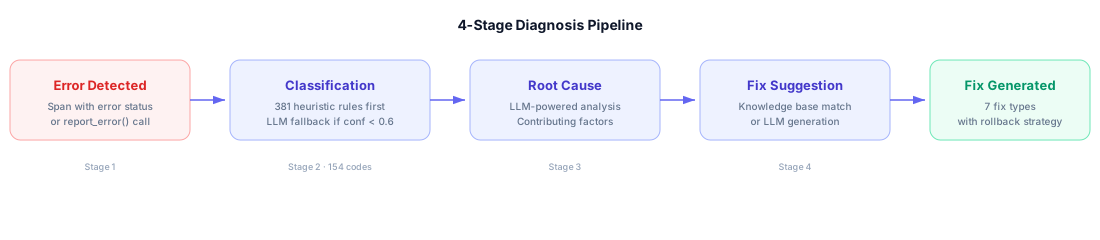
┌─────────────────┐     ┌─────────────────┐     ┌─────────────────┐     ┌─────────────────┐
│ Stage 1         │     │ Stage 2         │     │ Stage 3         │     │ Stage 4         │
│ Context         │ ──▶ │ Taxonomy        │ ──▶ │ Root Cause      │ ──▶ │ Fix             │
│ Extraction      │     │ Classification  │     │ Analysis        │     │ Suggestion      │
│ (~100ms)        │     │ (~1s)           │     │ (~2s)           │     │ (~500ms)        │
└─────────────────┘     └─────────────────┘     └─────────────────┘     └─────────────────┘
Stage 1: Context Extraction
Purpose
Gather all relevant information from the error trace.
Process
-
Identify error span
- Find span with
status: error - Extract error message and stack trace
- Find span with
-
Collect parent chain
- Walk up the span tree
- Include agent contexts
- Include phase contexts (think/decide/act)
-
Gather sibling spans
- Preceding spans (what happened before)
- Following spans (if any)
-
Extract content
- LLM prompts and completions
- Tool inputs and outputs
- Agent messages
Context Window Management
MAX_SPANS = 50
MAX_TOKENS = 100_000

# Priority order for inclusion:
# 1. Error span (always)
# 2. Direct parents (always)
# 3. LLM spans (high priority)
# 4. Tool spans with errors (high priority)
# 5. Recent sibling spans (medium priority)
# 6. Older context (low priority, summarized)
Output
{
  "error_span": { ... },
  "parent_spans": [ ... ],
  "context_spans": [ ... ],
  "llm_content": [
    {"role": "system", "content": "..."},
    {"role": "user", "content": "..."},
    {"role": "assistant", "content": "..."}
  ],
  "tool_io": [
    {"tool": "search", "input": "...", "output": "..."}
  ],
  "metadata": {
    "agent": "researcher",
    "phase": "act",
    "iteration": 2
  }
}
Stage 2: Taxonomy Classification
Purpose
Map the error to a specific code in the error taxonomy (154 codes across 10 modules and 31 categories).
Heuristic-First Classification
Before invoking an LLM, Risicare runs a pattern matcher with 379 regex and keyword rules against the error message, stack trace, and span attributes. Each rule maps to a specific error code.
- If a rule matches, the classification is accepted immediately with a fixed confidence of 0.9 (typically under 10ms).
- If no rule matches, the error is forwarded to the LLM classifier.
This heuristic-first approach handles the majority of common errors without an LLM call, significantly reducing latency and cost.
LLM Classifier (Fallback)
Model: meta-llama/Llama-3.3-70B-Instruct-Turbo via Together.AI - fast, cost-effective classification for errors that the pattern matcher cannot classify. gpt-4o-mini is used instead only when an OpenAI key is configured (production has none).
Prompt Structure
System: You are an AI agent error classifier. Classify errors into this taxonomy:

[TAXONOMY DEFINITION - 10 modules, 31 categories]

Rules:
- Choose the most specific code that fits
- Confidence must be 0.0-1.0
- Explain your reasoning briefly

User: [EXTRACTED CONTEXT]

Error: {error_message}
Stack trace: {stack_trace}
Agent: {agent_name}
Phase: {phase}
Output
{
  "module": "TOOL",
  "category": "EXECUTION",
  "subcategory": "TIMEOUT",
  "error_code": "TOOL.EXECUTION.TIMEOUT",
  "confidence": 0.92,
  "reasoning": "The error occurred during tool execution with a 30s timeout. The API call exceeded the configured timeout limit."
}
Confidence Thresholds
Classification confidence controls one thing: whether Stage 2 falls back from the fast rule-based classifier to the LLM classifier.
| Confidence of fast classification | Action |
|---|---|
| >= 0.6 | Accept the fast classification; no LLM call is made for Stage 2 |
| < 0.6 (or no fast match) | Re-classify with the LLM classifier |
The threshold is min_classification_confidence, default 0.6.
Confidence does not route between stages
Stage 3 (Root Cause Analysis) runs unconditionally on every diagnosis, at every confidence level. There is no "escalate to Stage 3" path, no "proceed directly to Stage 3" shortcut, and no flag-for-review state — a diagnosis either completes all stages or fails.
Fix suggestion threshold
In Stage 4, suggested fixes require a minimum confidence of 0.5 to be included in the diagnosis output. Fixes below this threshold are discarded.
Stage 3: Root Cause Analysis
Purpose
Determine why the error actually occurred, not just what happened.
Model
meta-llama/Llama-3.3-70B-Instruct-Turbo via Together.AI - deep reasoning capabilities. gpt-4o is used instead only when an OpenAI key is configured (production has none).
Analysis Framework
- Proximate cause: What directly caused the error?
- Contributing factors: What made it more likely?
- Underlying issues: What systemic problems exist?
- Prevention: How could this be avoided?
Prompt Structure
System: You are an expert debugger for AI agents. Analyze root causes deeply.

Consider:
- Was this a one-time issue or systemic?
- What assumptions failed?
- What dependencies failed?
- What could prevent recurrence?

User:
Classification: {error_code}
Context: {extracted_context}
Output
{
  "root_cause": "External API timeout due to unexpectedly large payload",
  "contributing_factors": [
    "Payload size (2.5MB) was 25x larger than typical",
    "No retry logic configured",
    "No payload size validation before API call"
  ],
  "reasoning_chain": "The tool call sent a 2.5MB payload, the API call exceeded its 30s timeout, and nothing retried it.",
  "evidence": [...],
  "confidence": 0.85
}
The API returns root_cause, contributing_factors and confidence from this result; reasoning_chain and evidence stay inside the pipeline.
Stage 4: Fix Suggestion
Purpose
Recommend actionable fixes ranked by confidence.
Process
-
Template-first lookup
- Apply a deterministic fix template keyed by
error_code - Templates produce a validated fix config for the error type
- Apply a deterministic fix template keyed by
-
LLM fallback (if no template matches)
- Generate a fix based on the root cause
- Validate fix configuration
-
Ranking
- Score by root cause alignment
- Score by implementation complexity
Stored knowledge base is planned, not built
A persistent cross-diagnosis knowledge base (the knowledge_patterns / fix_templates tables) is planned but not yet implemented — those tables do not exist in production. Stage 4 today is template-first plus LLM fallback only; there is no embedding-similarity lookup.
Fix Types
| Type | Description |
|---|---|
prompt | Modify system prompt |
parameter | Adjust LLM parameters |
tool | Fix tool configuration |
retry | Add retry logic |
fallback | Add fallback strategy |
guard | Add validation |
routing | Change agent routing |
Output
{
  "suggested_fixes": [
    {
      "fix_type": "retry",
      "confidence": 0.85,
      "description": "Add exponential backoff retry for timeout errors",
      "config": {
        "max_retries": 3,
        "initial_delay_ms": 1000,
        "exponential_base": 2.0,
        "max_delay_ms": 30000,
        "jitter": true,
        "retry_on": ["TOOL.EXECUTION.TIMEOUT"]
      }
    }
  ]
}
Pipeline Monitoring
Metrics
| Metric | Description |
|---|---|
diagnosis_latency_ms | Total pipeline time |
stage_1_latency_ms | Context extraction time |
stage_2_latency_ms | Classification time |
stage_3_latency_ms | Root cause analysis time |
stage_4_latency_ms | Fix suggestion time |
classification_confidence | Stage 2 confidence |
Error Handling
If any stage fails:
- Log error with context
- Return partial diagnosis
- Mark diagnosis as incomplete
- Queue for retry (max 3 attempts)