Documentation
Observability and error classification for AI agents.
Risicare traces your AI agents — their LLM calls automatically, and their tool calls, decisions and hand-offs when you add the SDK's decorators — and gives an error code from a 154-code taxonomy to an exception that leaves a traced call. These docs show you how to instrument your agents, read their traces, and see how their failures are classified.
Quick Start
Get started in 5 minutes with our Quickstart Guide. Risicare is in private beta: access is by invitation, and the quickstart shows how to sign in.
What is Risicare?
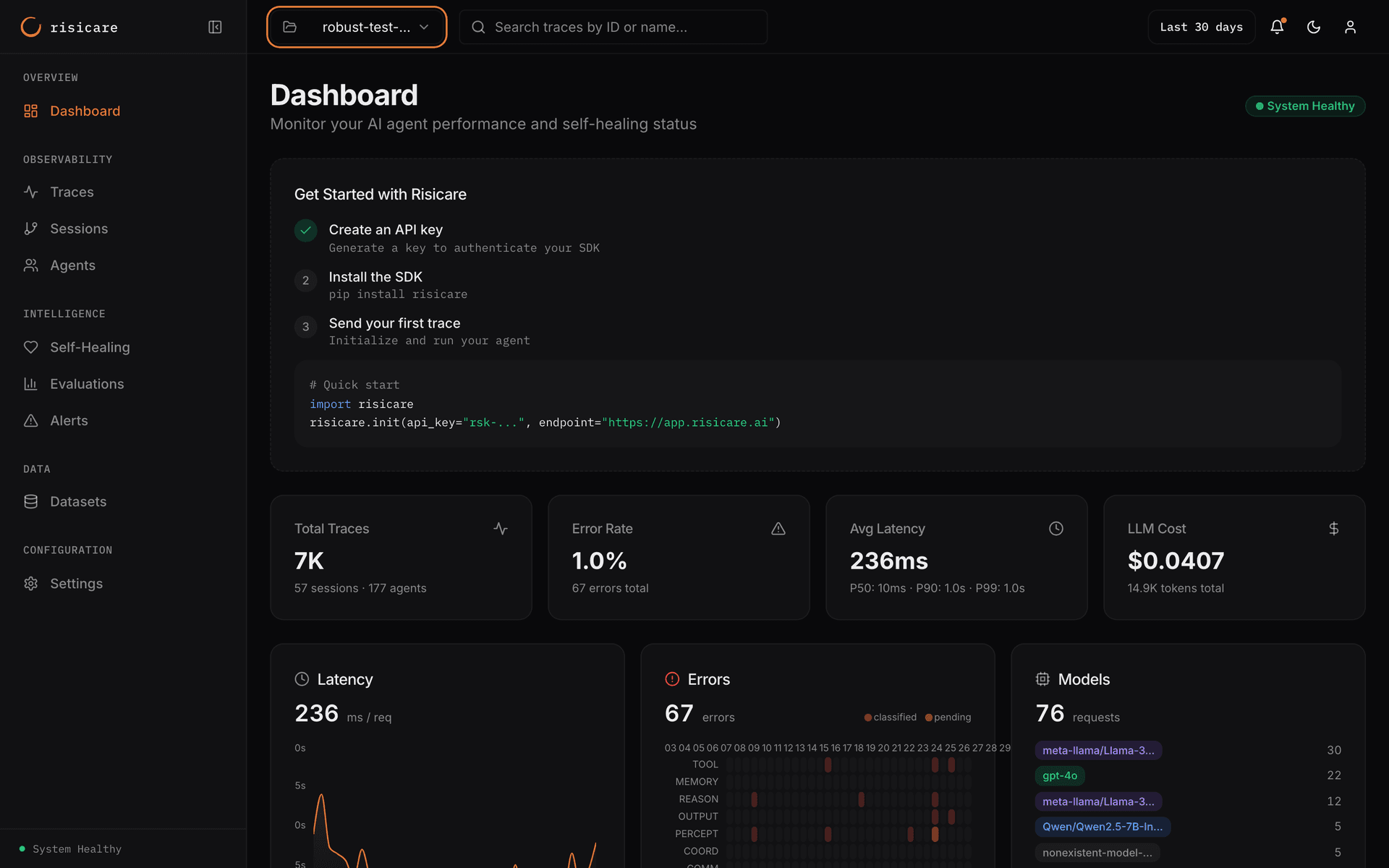
Risicare is an observability platform for AI agents. It provides:
- Automatic Instrumentation - Trace LLM calls with
import risicareand two environment variables in Python, or withinit()and apatchX()call in JavaScript - Decision-Level Observability - Track THINK/DECIDE/ACT phases
- Error Classification - An exception that leaves a traced call gets a code from a 154-code taxonomy. The SDK assigns 19 of the codes, the same in Python and JavaScript (details)
- Diagnosis and Fix Recommendations (held) - Root-cause analysis and fix recommendations across 7 fix types are built and held for the beta; no new diagnosis or fix recommendation is produced today (details)
- Self-Healing (not enabled) - Fix deployment (canary rollout with automatic rollback) and A/B testing are built but not enabled in this release; a fix cannot be promoted and a deployment cannot be created. The learning stage is not connected (details)
Quick Links
Quickstart
Get tracing working in 5 minutes
View Dashboard
Explore the observability dashboard
Workflow
The docs follow the product's workflow. Instrument and Observe work today, and every failure is classified; root-cause diagnosis and fix recommendations are held for the beta; fix deployment is built and gated off:
Instrument
Add observability to your agents
Observe
View traces, spans, and sessions
Diagnose
Error classification; diagnosis is held
Heal
Fix recommendations — held for the beta
Deploy
Canary and A/B deployment — built, gated off
Admin
Manage projects and team
Progressive Integration
| Tier | Code | What You Get |
|---|---|---|
| 0 | import risicare + RISICARE_API_KEY + RISICARE_TRACING=true | LLM calls of the supported providers traced |
| 1 | risicare.init(...) | Explicit configuration |
| 2 | @agent() | Agent identity tracking |
| 3 | @session | User session grouping |
| 4 | @trace_think/decide/act | Decision phase tracking |
| 5 | @trace_message/delegate | Full multi-agent support |